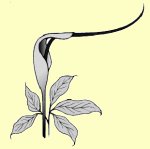
Arisaema dracontium
(green dragon, dragon root)
Home page
Plant profiles
|

The Genus Physaria
by Michelle Jones Ham
Often described as an ugly duckling that doesn't metamorphosize into a beautiful swan,
Physaria is an under-rated genus often overlooked when considering alpine plants for the garden. A native of the Northwestern United States, they are generally hardy through Zone 4.
Of the family Cruciferae, there are 14 known species. They are tufted, tap-rooted plants with silvery, felted leaves and elongated racemes of four-petalled yellow flowers that grow into very interesting inflated seed pods. Most species grow no more than
4 inches high by 8 inches wide. Because the flower stalks frequently lie horizontally upon the surface, they are shown to best advantage planted in scree.
Physaria is also suitable for the rock garden, raised bed, large trough or alpine house.
Physaria can be propagated by seed when ripe (70
degrees Fahrenheit) or in the cold frame in Spring (40 to 70 degrees Fahrenheit). Seeds of
Physaria species are occasionally
offered in the NARGS Seed Exchange not only in the Garden Collected Section, but also in the Wild Collected Section. Species have to date been very limited. Newly developed, lateral
rosettes can also be propagated as cuttings in late summer. Cuttings root best in sand.
I currently grow 3 of the 14 species. Physaria
eburnifoliais planted in a raised scree bed and has grown to about
3inches high by 5 inches wide. This past spring it was surrounded by lateral stems of pale yellow flowers radiating out from the silver-suede
rosette of elliptical basal leaves. It remained in flower for almost 3 weeks and then developed clusters of inflated seeds pods. Harvesting the seeds is very easy as they are relatively large and kidney shaped and can be extracted from the seed pod by carefully crushing the filmy pod and blowing away the chafe.
Physaria alpina is planted on a north-facing slope in my open scree bed. Similar to
Physaria eburnifolia in appearance, but with deeper yellow flowers that are shaded at the base with orange tints.
I grew Physaria didymocarpa from seed obtained from the Seed Exchange this year. It was easy to
propagate and grew on well in a more rocky section of my garden throughout the summer months. It 's leaves are smaller and slightly lyrate, unlike the above two species.
I encourage more rock gardeners to try Physaria
in your gardens. In addition to finding seeds listed in the NARGS Seed Exchange, species can be found in the Siskiyou Rare Plant Nursery and Arrowhead Alpines catalogues.
Web design and maintenance by Craig
Cramer, cdcramer@twcny.rr.com
|