Arisaema dracontium (green dragon, dragon root)
Arisaema dracontium 
(green dragon, dragon root)

Home page

Plant profiles

Adirondack Chapter, North American Rock Garden Society

Cimicifuga racemosa

by Bill Plummer

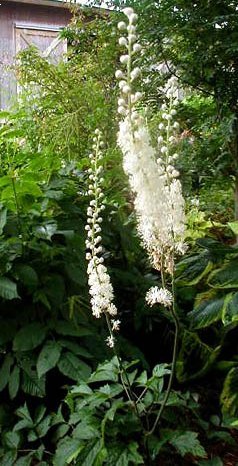
Cimicifuga racemosa - Click for larger imageBugbane, Black Snakeroot, Black Cohosh, Fairy Candles are but a few of the common names given to this stately denizen of the woods. Its Latin name is a literal translation of bugbane. (Cimex, bug and fuga, flee.) 

A native plant ranging from western Massachusetts through southern Ontario to Minnesota south to Missouri and Georgia. I've had it for, I don't know how many years. It is well established and seeding itself around. 

The foliage is strikingly familiar to that of the baneberries, also in the Ranunculaceae family. I had accepted it as a welcome addition to the woods garden for its summer blooming period. But the other morning while eating breakfast on our sun porch, I gazed down into the back woods as the morning sun came through a break in the canopy and lit up the candelabras on two of my plants. That play of light and shadow made a very dramatic and impressive effect. The next evening while having dinner, again on the sun porch, the western sun streamed through in like fashion and relit the candelabras. 

Books list it as growing from 3 to 6 feet or 3 to 8 feet. I vote for the latter, as one of mine measured out as 7 ½ feet. The number of racemes on a stalk can vary. From one to four (or more). And a plant can have multiple stalks. One of mine has three stalks with three or four racemes per stalk for a total of 11 racemes. Each raceme can be up to 16 inches long. The small white flowers start blooming at the bottom and as they become pollinated the sepals and petals fall, leaving the lone pistil. The other day I watched a fly of some kind flit from one flower to another. Unfortunately I did not have my camera at the time. 

One of my gardening books says that it prefers more sun than most wildflowers. Not so. My plants are growing in "deep" shade and thriving. In my lower woods there are trees to the east, south and west, so that the shade is almost continual. All my other books list it as a plant for shade. However at Wylatt's and Mary's garden their plants were growing in "full" sun. The conclusion: Bugbane is adaptable from full sun to deep shade, provided it has rich, moist soil. Or as another describes it, "undemanding". Because of its height, I am using it to screen my work area and compost heap. I use it also as a background plant and as specimen plants. Recommended transplanting times are usually given as spring or fall and one book states that it is difficult to transplant. I am glad I moved three of my plants last week before I read that statement - two of them over six feet tall. I also potted up two small plants for our August plant sale.

Another native bugbane is Cimicifuga americana, growing to three feet tall and ranging from Pennsylvania south. Other species are: C. dahurica, C. elata, C. japonica, C. foetida, C. laciniata, C. rubifolia and C. simplex. Two selected forms are C. simplex 'White Pearl' and C. simplex ramosa atropurpurea.


Web design and maintenance by Craig Cramer, cdcramer@twcny.rr.com