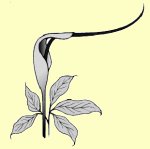
Arisaema dracontium
(green dragon, dragon root)
Home page
Plant profiles
|

The Genus Acantholimon
by Michelle Jones Ham
Who could resist the slides of little buns smothered in pink that Mike Slater shared with us during his visit several years ago? What are they? What are those little buns covered in pink blossoms? One of his favorites and now mine -
Acantholimon. Of the family Plumbaginaceae, there are 120 species of near evergreen, sub-shrubs, buns, or cushions. They are native to arid, eastern
Mediterranean and central Asian regions.
Acantholimons are cushion, to mat-forming, densely spiny, rigid plants, with nearly
vertical leaves. They increase fairly rapidly if situated in a sunny, hot, well drained location, with deep poor soil. They will do best if not watered directly on the leaves and are protected against winter wet.
Given the above conditions they are very versatile and will do well in a scree, raised bed, crevice garden, rock wall, rock garden or alpine house. Most reach dimensions that are not suited to a trough. Regardless of where you choose to plant it position it wisely. Plant it away from re-seeders or rampant spreaders, as it is difficult to weed around the cushions, they are so prickly.
Acantholimons flower during the summer months and bear funnel-shaped calyx with 5 flared bright pink petals that sit right on top of the blue-tinged foliage. They are lime lovers and appreciate a light surface application of lime each spring.
Obtaining viable seed from Acantholimon grown in cultivation is rare. However, viable seed will germinate within 1
to 4 weeks in early spring at 60 to 70 degrees Fahrenheit. Plants can also be divided in early- to mid-spring and set out into a garden frame.
Reputed to be somewhat tender and usually recommended for Zone 6 gardens, I have had 4 different species growing in my Zone 5 garden for the past few years.
I germinated seed from Panioti Kelaidis of Acantholimon caryophyllaceum this past spring and passed along sister seedlings to both George Erdman and Rick Lowenstein. The yearling I retained has been planted at the top slope of a flat rock in the raised bed to bake in the sun. It has increased in size by growing off-shoots that circle the entire base of the seedling. It appears to be doing very well. I'd be very interested in hearing how Rick's seedling does in his Zone 4 garden.
Acantholimon bracteatum ssp captitatum is also planted in the raised bed at the base of a rock outcropping. It has
tripled in size over the past year. This summer it had a cluster of bright pink flowers that when the sun hit them in the morning looked like they had been sprinkled with sugar. So dainty and beautiful.
Acantholimon ulicinum ssp ulicinum is in the open rock garden, lodged in a narrow channel between two large rocks. This space has forced its growth upward, and it reminds me of a porcupine trying to burrow into the soil. I planted this species so it received the advantage of the radiant heat from the rocks and it has done the best of all of the species I have. It is a young plant and has not bloomed yet, but with its increase in size and robust health, I hope it is nearing the "profusion of pink-covered bun" stage.
And last but not least, I have Acantholimon armanum ssp armanum, planted in the rock crevice garden. It had been planted elsewhere, but I very carefully dug it out with a large clump of soil, not disturbing the tap root, and replanted it in the crevice garden. One section of the outer edge died, but the rest of the plant seems to have recovered. It had bloomed this past summer sparingly. The blossoms were very pale pink, with a darker pink edge, nearly
unnoticeable. The foliage is bolder blue and very spiny, but the flowers are not as distinguished as the darker pink species.
If you want to try your hand at germinating Acantholimon seeds, they can be obtained through the NARGS, AGS, and SRGC Seed Exchanges. Or you may find
Acantholimon species available through Alpine Mt. Echo, Siskiyou, Laporte, Mt. Tahoma, and Arrowhead Alpines Catalogues. Arrowhead Alpines has by far the most extensive selection.
Web design and maintenance by Craig
Cramer, cdcramer@twcny.rr.com
|